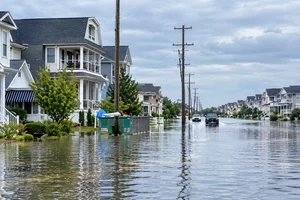
Margate Targets Flooding in the Minnie Creek Area
Margate City has secured $2 million in federal hazard-mitigation funding for improvements to the Minnie Creek drainage system.
The project focuses on a low-lying back-bay residential area where flooding can become particularly difficult when heavy rainfall occurs during elevated tides.
Under those conditions, stormwater attempting to drain toward the bay can encounter high water levels that prevent normal gravity-fed drainage.
The FEMA funding gives Margate another tool for addressing that recurring problem through permanent infrastructure.
How Back-Bay Flooding Creates a Drainage Problem
Storm drains generally depend on water being able to move away from streets and toward an appropriate discharge point.
In a barrier-island environment such as Margate, high bay levels can interfere with that process.
When the receiving water is already elevated, stormwater may drain slowly or become trapped within low areas. In some situations, bay water can also move backward through portions of the drainage system.
That combination is particularly important around Minnie Creek, where the city's planned work is aimed at controlling both stormwater and tidal backflow.
What the $2 Million Project Will Change
The FEMA-funded project is expected to modernize the Minnie Creek drainage collection network.
One of the specifically identified improvements is the installation of inline check valves.
These valves are designed to allow drainage water to move in its intended direction while reducing the ability of bay water to travel backward through the system and emerge through street-level catch basins.
For nearby Margate residents, that is an important distinction. The project isn't simply about collecting rainwater more efficiently. It is also intended to address the interaction between the city's drainage system and elevated bay water.
Federal Funding Reduces the Local Burden
The $2 million award comes through the Federal Emergency Management Agency's hazard-mitigation program.
Using federal mitigation funding allows Margate to pursue the drainage improvements without relying entirely on locally financed municipal debt.
The project also fits into Margate's broader flood-management efforts as a developed barrier-island community with both oceanfront and back-bay exposure.
Infrastructure such as catch basins, underground drainage pipes, and check valves may receive little attention during normal weather, but their function becomes much more visible during heavy rain combined with high tides.
How Flood Programs Connect to Insurance
The research packet also identifies Margate's participation in the National Flood Insurance Program's Community Rating System.
The program recognizes qualifying municipal flood-management practices and can result in flood-insurance premium discounts for property owners within participating communities.
Drainage projects are therefore part of a broader municipal flood-management framework rather than isolated construction projects.
For Margate homeowners, especially those in low-lying back-bay sections of the city, the Minnie Creek investment is one example of how municipal infrastructure, federal mitigation funding, and community-wide flood planning can intersect.
What Happens Next in Minnie Creek
The key issue to watch is the implementation of the drainage upgrades funded through the $2 million FEMA award.
The packet identifies modernization of the drainage network and inline check valves as central pieces of the project.
Once installed, the system is intended to provide another layer of protection against the backwater conditions that occur when elevated bay levels interfere with traditional drainage.
For a developed community such as Margate, where streets and homes already occupy much of the available land, projects like Minnie Creek focus on improving the infrastructure underneath existing neighborhoods rather than changing the neighborhood itself.
Sources: Shore Local Newsmagazine